
I have a soft spot for weird old computers, there is no secret about that…
From time to time, some of these machines become legends. The NeXT computers definitely belong to this category. But, what is very special about them … is that my personal history crossed their paths a few times. They left a indelible mark in my memory and in my heart …
Ever since I got into that damned vintage computer hobby, I wanted a NeXT computer. I searched for years. In France, they are basically unobtainium. Once in a while, though, one of them (or sometimes parts of them) are showing up. But the prices then are completely bonkers.
So … I chose another path.
The NeXT Cube was introduced in 1988, at a time when personal computers were boring beige boxes. It looked like something that had escaped from … outer space: a perfect black cube, a multitask Unix-based operating system (NeXTStep), an onboard Motorola 56001 DSP, a magneto-optical storage, an object-oriented development environment, Display Postscript and a Graphical User Interface that was years ahead … of anything else.
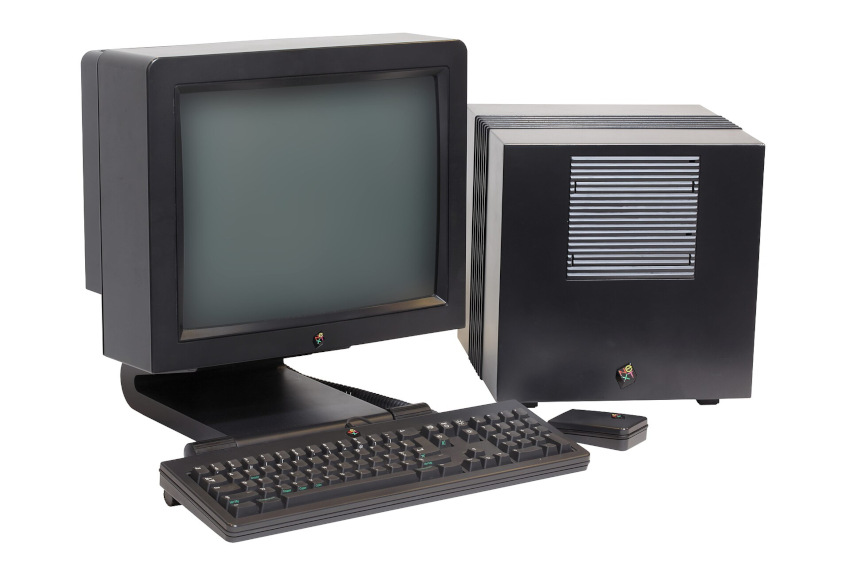
It was NOT a personal computer. It was a workstation. It was designed – at least, at first – for High Education and Researchers. At a time when I was a young particle physicist, and started working daily on Unix workstations at my home research lab. Mostly on HP9000 series 300/400. Sometimes on SparcStations. Sometimes on AIX-based machines.
Unix-based and Unix-like computers became my daily driver. They are still today, in one form or another: on Linux-based machines and on MacOS X. Which … by the way …, is a direct descendant of NeXTStep.
During my PhD, when I started working on experiments at CERN in the early 90’s, I had the chance to cross the path of many geniuses. Some were physicists and mathematicians. Some were members of the IT Staff. Robert Caillau and Tim Bernes-Lee were some of them.
Tim Berners-Lee had the first Web server and browser running at CERN, directly developing the software on a NeXT computer. The first website, ran on that machine. A machine … that I did physically touched.
At my home research lab was using the CC IN2P3 calculs infrastructure. There, Daniel Charnay and the late Wojciech Wojcik ran the first French web server. On a NeXT Cube. A maybe a NeXT Station, my memory is a bit fuzzy (I’m sure there was a NeXT Station in Wojciech’s office though)
The web changed my life. When I quit academia in early 2000’s I jumped into the web revolution with my first startup. All this chain reaction started with NeXT machines. I feel connected to them.
But NeXT machine are almost impossible to get on the second-hand market. Too rare. Too damn expensive.
And then I found the project that provided the perfect starting point…
A 10 cm NeXT Computer
Nina Richards is a faboulous british designer. She designed a 10x10x10 cm NeXT Computer replica. The model is made from several 3D-printed pieces: the main body, the front panel, the fins, the rear section and the internal tray that carries the Raspberry Pi.
This is exactly the kind of project I like: the outside is pure retro-computing nostalgia, while the inside is completely modern.
Nina’s intention was to host a web server on a Raspberry Pi 3, inside the model. I wanted a NeXT computer. I wanted to run NeXTStep. So I opted for a more modern and powerful solution: a Raspberry Pi 5, running the a NeXT emulator.
For this, I had to tinker a bit with Nina’s design, to accomodate the Raspberry Pi 5 factor. At the time, I did not have a 3D printer.
This is were PCBWay entered (no sponsor there, everything is paid with my own money). I had a nice experience with their 3D printing services for my MO5. So … I sent the STL files, chose the right options from their very frendly online form.
A few minutes later, I had a quote. A few weeks later, I received the model!
I must say … I was amazed by the print quality:
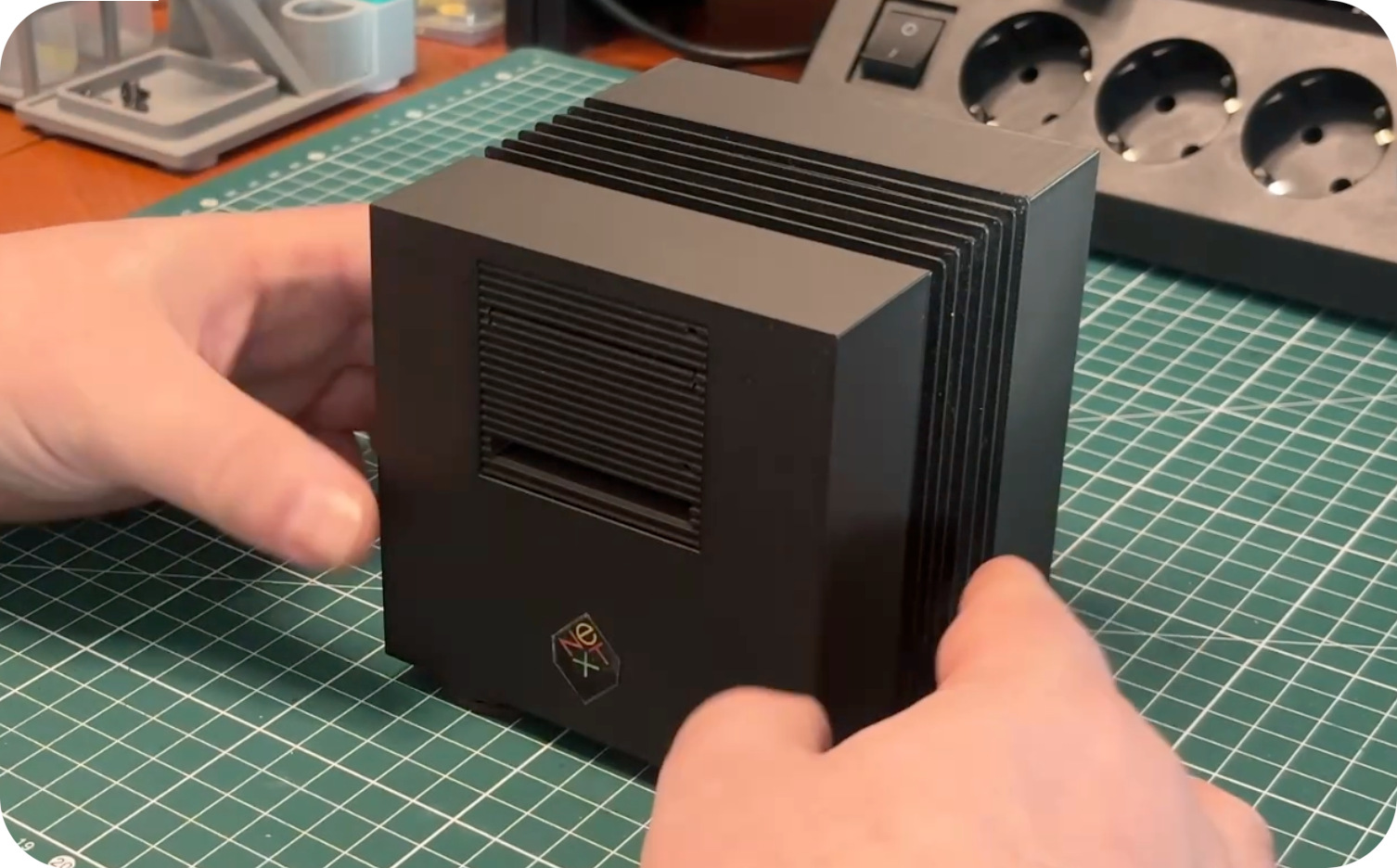
Previous is NeXT
It is starting to look like a NeXT computer. Buf if I am going to build a NeXT computer, I want to run and experience the NeXT desktop on my screen!
The solution is Previous, an open source NeXT computer emulator. It is based on the famous Hatari emulator. It can emulate several generations of Motorola 68k NeXT hardware, including the original NeXT Computer, NeXTcube Turbo, NeXTstation and their variants.
I went through the process of getting the sources on a Raspberry Pi, preparing the software, obtaining the necessary ROMs and disk images, building the emulator from sources and configuring it.
One Step Further
Once the 3D model, the hardware and the emulator were ready, the fun part started. Booting a NeXT system today is an amazing experience.
I took the time to install various software, including Lotus Improv, Mathematica, Wordperfect, Framemaker and even Games. And yes, Doom runs on NeXT computers!
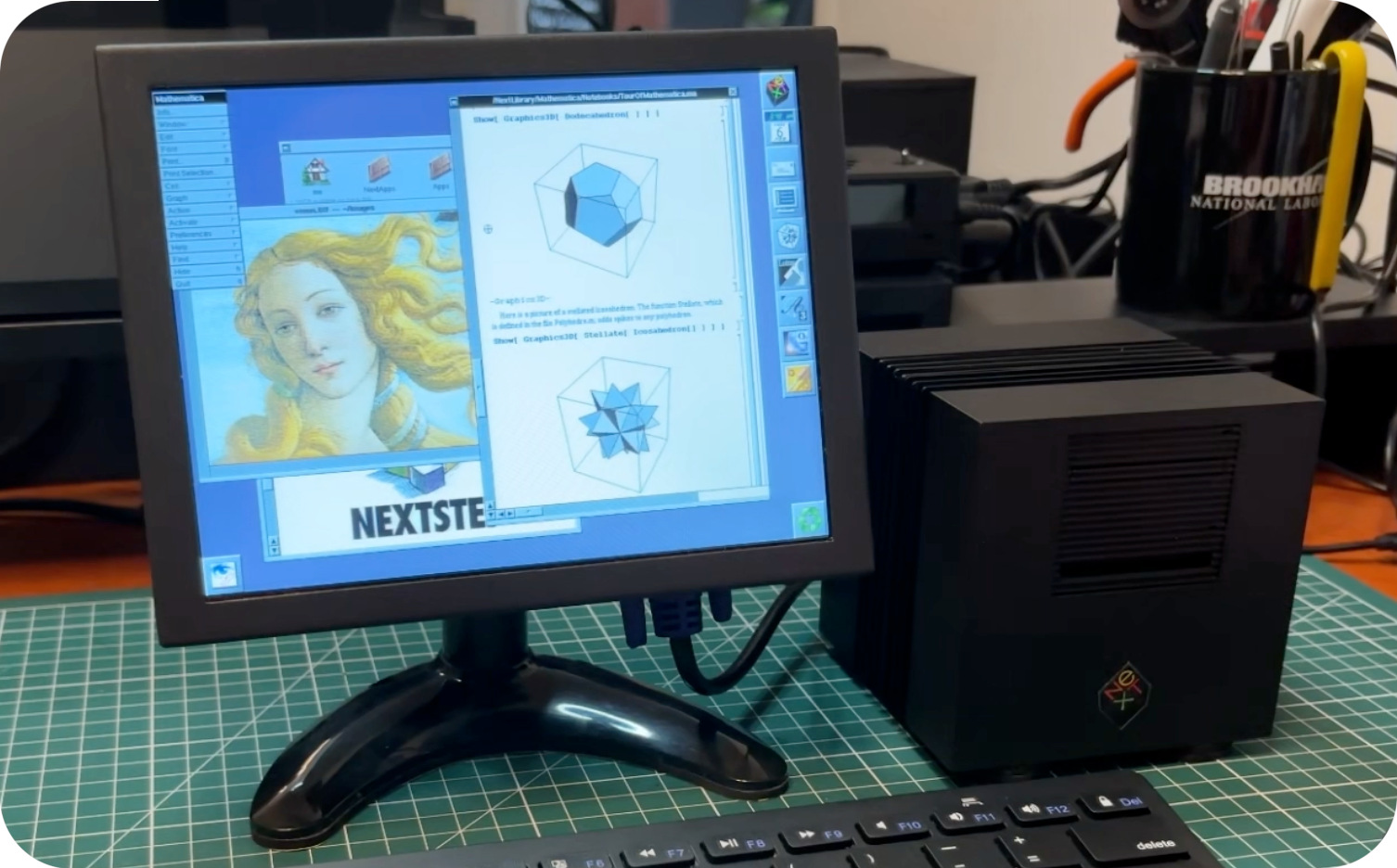
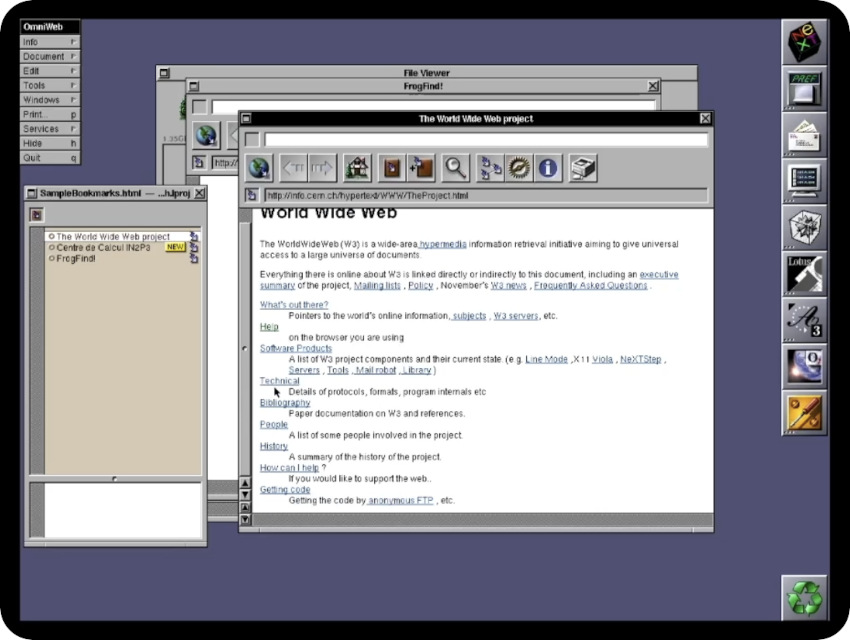
Finally, I wanted to experiment the good old time web, browsing the very first web pages:
YouTube video:
Here is the full video published on the Quantum-bits YouTube channel:
There are plenty of retro computers that are more common, cheaper and easier to collect. NeXT computers are interesting for a different reason. They sit at a crossroads between hardware design, operating-system architecture and the history of the modern software industry.
That makes the little black cube more than an object of retro-computing nostalgia. It is a small piece of the history of computing itself. This mini NeXT cube isn’t just a model. It is – for me – a little time machine.
Links:
- nina | makes (Nina Richards original design): https://www.ninamakes.co.uk
- Thingiverse (STL Files): https://www.thingiverse.com/thing:2884543
- Previous emulator: https://previous.nextcommunity.net/
- Previous (source code): https://sourceforge.net/p/previous/code/HEAD/tree/trunk/
- Winworld Online Museum (NeXTStep images): https://winworldpc.com/product/nextstep/3x
- ROM files: https://www.nextcomputers.org/NeXTfiles/Software/ROM_Files/
- Software for NeXT: https://fsck.technology/software/NeXT/
- PCBWay 3D printing services: https://www.pcbway.com/rapid-prototyping/3d-printing/
- FrogFind: https://frogfind.com/ and ActionRetro: https://www.youtube.com/ActionRetro